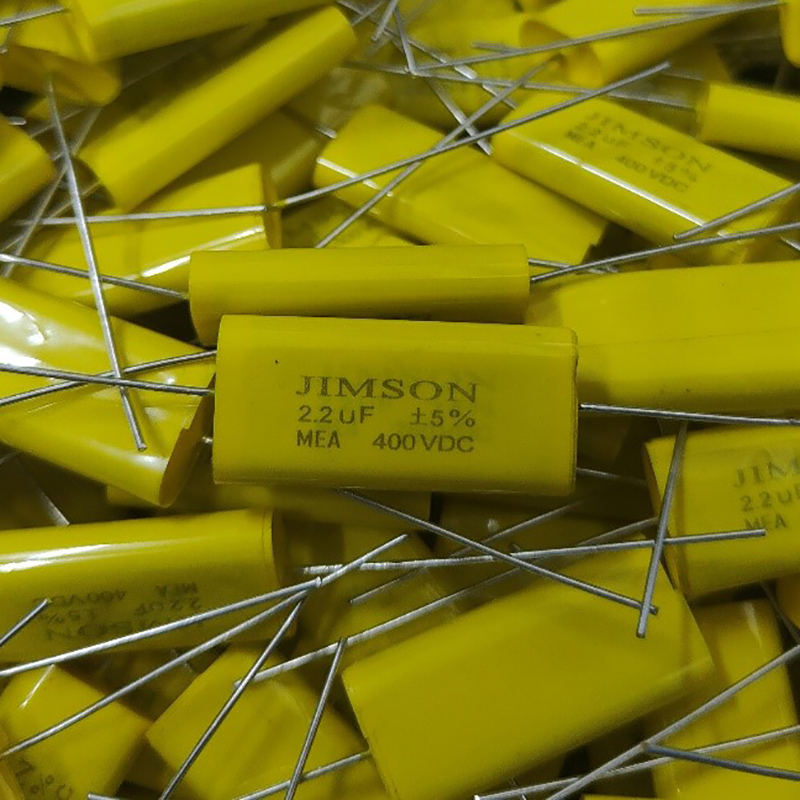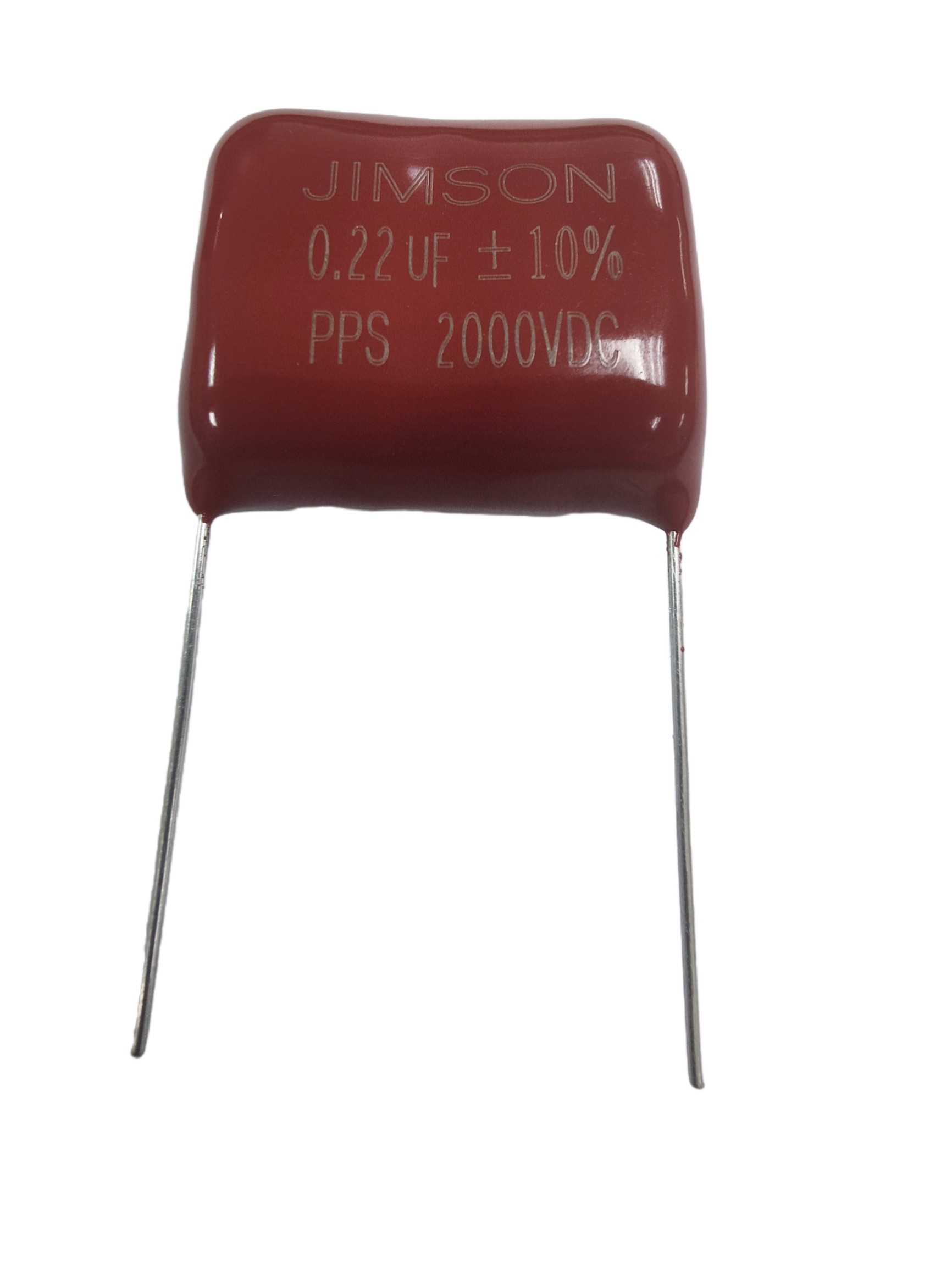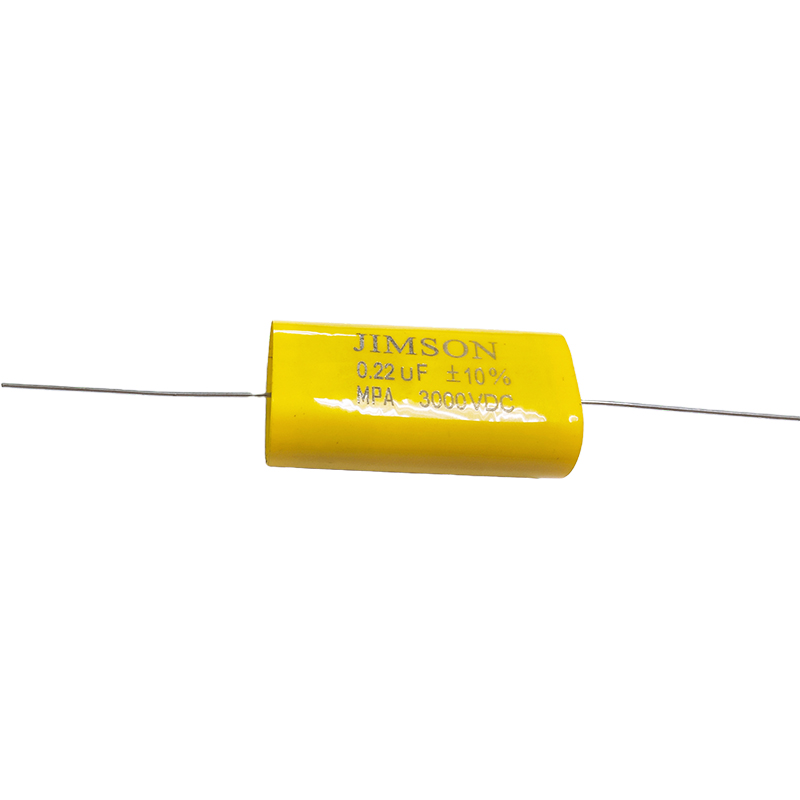
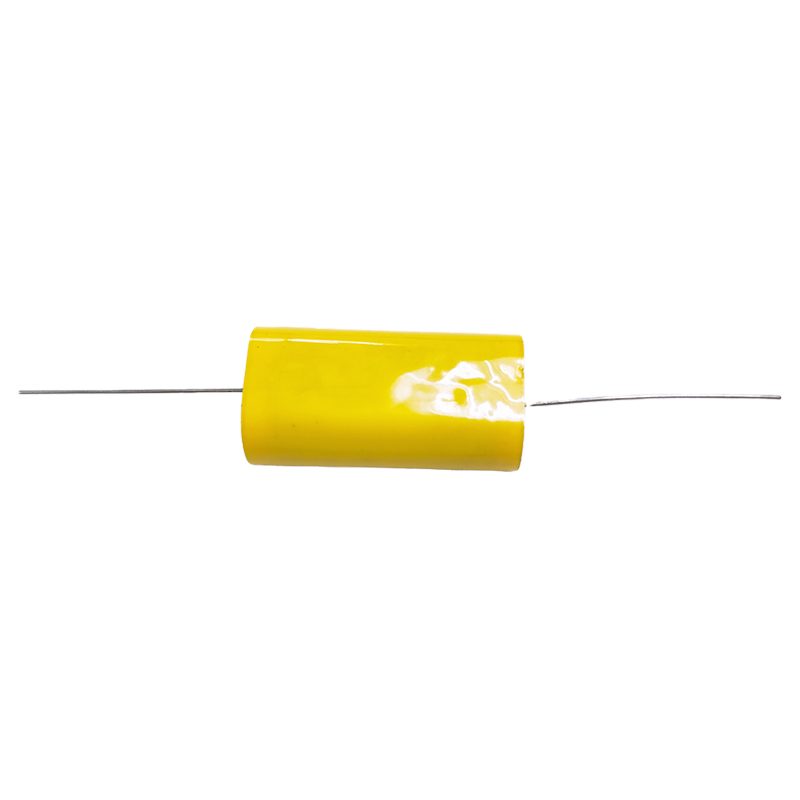
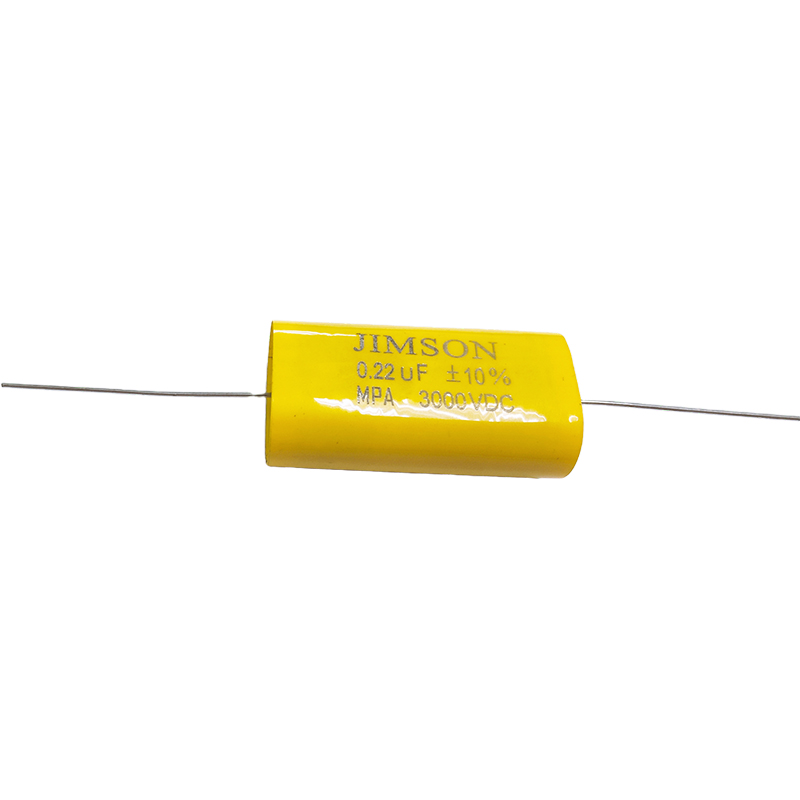
0.22uF CBB20 Axial Polypropylene Capacitors Specifications:
| Diélectrique | Film polypropylène |
| Électrodes | Métal évaporé sous vide |
| enrobage | Out Wrapped with Mylar tape and ends sealed with epoxy resin |
| Fils | Fils axiaux en fil étamé |
| Norme de référence | CEI 384-16 ; GB 10190-1988 |
| Catalogue climatique | 40/85/21 |
| Capacité par rapport à la tension nominale (UR) | 0.01μF-6.8μF/100VDC 0.01μF-6.8μF/250VDC 0.01μF-1.5uF/400VDC 0.01μF-1.0uF/630VDC |
| Tolérance de capacité | M = ±20 %, K = ±10 % et J = ±5 % |
| Facteur de dissipation | DF≤0.1% (at 20°C, 1KHz) |
| Résistant à la tension | Unité 1,6*UR : VCC (5 s à 20°C) |
| La resistance d'isolement | C≤0.33µF, IR≥30000MΩ, C>0.33µF, IR*C≥5,000s (1 minute at 20°C and RH≤65%) |
| Endurance | 1000 heures avec 125 % de la tension nominale à 85°C. Après l'essai : ΔC/C ≤5 % ; ΔDF ≤0,40 %, IR ≥50 % de la valeur spécifiée (20°C, 1 kHz) |
Metallized axial polypropylene capacitors are also known as film capacitor, the film here does not refer to the film plated on the surface of similar chip resistor, but refers to the film capacitor medium is made of layer by layer polypropylene film rolled up.
Matériau diélectrique : film de polypropylène, qui est le matériau du film diélectrique au milieu.
Matériau de l'électrode : deux feuilles métalliques, qui sont des couches vaporisées de métal, enveloppées d'un film de polypropylène et roulées à la bonne taille, qui est la forme originale du condensateur à film.
Matériau de la coque : coque en plastique PBT ignifuge, isolant, qui joue le rôle de protection et d'isolation.
Matériau d'étanchéité : résine époxy ignifuge, isolant, qui joue le rôle de fixation et d'isolation.
Matériau du fil : fil d'acier recouvert de cuivre étamé, deux fils sont connectés à une feuille de métal chacun pour former deux électrodes externes du condensateur.
1.Construction non inductive et auto-guérison
2.Low DF and high IR
3.High capacitance value available and compact size
1. Couplage, découplage, dérivation et circuit de synchronisation
2. Automatic control system, communication equipment
3. Charging/discharging, lighting, noise suppression and frequency modulation

In the ever-evolving world of electronics, capacitors play a fundamental role as energy storage devices. Among the various capacitor types available, axial polypropylene capacitors stand out for their unique characteristics and versatile applications. In this comprehensive article, we will embark on a journey to explore the intricate details of axial polypropylene capacitors, from their fundamental principles and construction to their wide-ranging applications and recent advancements. By the end of this article, you will gain a deep understanding of these essential electronic components and their role in modern technology.
1.1 Understanding Capacitors
To comprehend the significance of axial polypropylene capacitors, it’s crucial to start with the basics. A capacitor is an electronic component designed to store and release electrical energy. It consists of two conductive plates separated by a dielectric material, which prevents direct electrical contact between the plates. The dielectric material’s properties determine the capacitor’s characteristics, including capacitance value and voltage rating.
1.2 Types of Capacitors
Capacitors come in various shapes and sizes, each tailored to specific applications. Common capacitor types include ceramic capacitors, tantalum capacitors, electrolytic capacitors, and film capacitors. Among these, film capacitors are highly regarded for their reliability and performance, making them suitable for a wide range of applications.
2.1 Introduction to Film Capacitors
Film capacitors, as the name suggests, employ a thin film of dielectric material as their key component. This dielectric material is typically made from polymers like polyester, polypropylene, or polycarbonate. Film capacitors are known for their excellent stability, low losses, and high capacitance values.
2.2 Polypropylene Capacitors
Polypropylene capacitors, in particular, are valued for their outstanding characteristics. Polypropylene, a thermoplastic polymer, serves as the dielectric material in these capacitors. Its unique properties, including a high dielectric constant, low dielectric losses, and exceptional self-healing capabilities, make it an ideal choice for demanding applications.
2.3 Axial vs. Radial: A Form Factor Comparison
Capacitors are available in various package styles, with axial and radial being two common configurations. Axial capacitors have leads extending from each end of the capacitor body, whereas radial capacitors have leads emerging from the same side. Axial polypropylene capacitors offer distinct advantages and are often preferred for specific applications.
3.1 Inside an Axial Polypropylene Capacitor
To appreciate the capabilities of axial polypropylene capacitors fully, let’s delve into their internal structure. These capacitors consist of multiple layers of polypropylene film wound together, forming a compact cylindrical shape. The winding technique and materials used significantly influence the capacitor’s performance.
3.2 Electrodes and Terminations
The conductive plates or electrodes inside the capacitor are crucial to its operation. These electrodes are typically made from metal foils, such as aluminum or copper. The choice of electrode material affects the capacitor’s reliability and performance.
3.3 Lead Styles and Package Sizes
Axial capacitors are available in various package sizes to accommodate different applications. The leads of axial capacitors can be straight or bent, depending on the intended use. Understanding these variations is essential when selecting the right capacitor for a specific project.
4.1 Capacitor Charging and Discharging
To understand how axial polypropylene capacitors function, it’s essential to grasp the basic principles of charging and discharging. When a voltage is applied across the capacitor terminals, it charges by storing electrical energy in the form of an electric field between the plates. The rate at which the capacitor charges and discharges depends on its capacitance and the resistance in the circuit.
4.2 Frequency Response and Capacitive Reactance
The behavior of capacitors varies with the frequency of the applied voltage. At low frequencies, capacitors act as open circuits, blocking the flow of direct current (DC). However, at higher frequencies, capacitors become increasingly conductive due to their capacitive reactance. Understanding this frequency-dependent behavior is crucial in designing circuits involving axial polypropylene capacitors.
5.1 Audio Equipment
One of the primary applications of axial polypropylene capacitors is in audio equipment. These capacitors are often used in crossover networks to improve audio signal quality and reduce distortion. Their low dielectric losses and high capacitance values make them ideal for delivering clear and crisp audio.
5.2 Power Supplies and Voltage Regulation
Axial polypropylene capacitors are essential components in power supplies, where they serve multiple purposes. They help filter out noise and ripple voltage, ensuring a stable and clean power output. Additionally, they play a vital role in power factor correction (PFC) circuits, enhancing the efficiency of electrical systems.
5.3 Motor Drives and Inverters
Motor drives and inverters require capacitors that can handle high ripple currents and voltage fluctuations. Axial polypropylene capacitors excel in these applications, providing reliable energy storage and ensuring smooth motor operation. Their self-healing properties also contribute to extended lifespan in these demanding environments.
6.1 Advances in Dielectric Materials
Recent research and development efforts have focused on improving the dielectric materials used in axial polypropylene capacitors. New formulations aim to enhance performance even further by reducing losses and increasing capacitance values.
6.2 Miniaturization and High-Density Capacitors
The electronics industry continually pushes for smaller and more compact components. Miniaturized axial polypropylene capacitors have emerged to meet this demand without compromising performance. High-density designs enable the incorporation of these capacitors into densely packed electronic assemblies.
6.3 Improved Temperature Stability
Enhancements in temperature stability have made axial polypropylene capacitors more resilient in extreme environments. This improved stability ensures reliable performance across a broader range of operating conditions.